Decentralized Energy Beyond Intermittent Renewables
BitsBreeze is pioneering next-generation energy technology that could revolutionize how the world produces clean, safe, and abundant power—without emissions, without waste, without limits.
Why the Energy Industry is Watching
A multi-trillion dollar market is seeking breakthrough solutions. Our technology addresses the fundamental limitations of current clean energy approaches.
Unlimited Fuel Supply
Our technology uses hydrogen—the most abundant element in the universe—extractable from ordinary water. No rare earth materials, no supply chain vulnerabilities.
Inherently Safe
Unlike conventional approaches, our process operates at near-ambient temperatures with no harmful radiation and no long-lived waste products.
Scalable & Distributed
From industrial plants to residential units—the technology scales from kilowatts to megawatts, enabling both centralized and distributed energy production.
Proven Science
Built on 30+ years of peer-reviewed research with experimental validation. Our approach is grounded in established physics, not speculative theories.
First Mover Advantage
Early entry into an emerging sector with high barriers to entry. Our team combines deep scientific expertise with industry partnerships.
Multiple Revenue Streams
Technology licensing, industrial applications, medical isotopes, and distributed energy systems create diverse monetization pathways.
Partner With Us
We're seeking strategic partners and investors who share our vision for transforming the global energy landscape.
A Decentralized, Clean, and Scalable Energy Source
For strategic investors with a long-term vision
Low-Energy Nuclear Reactions (LENR) are physical phenomena in which the controlled interaction between hydrogen (or its isotopes) and nanostructured metal materials—such as nickel or palladium—generates anomalous heat, not attributable to known chemical reactions. The process occurs at temperatures and pressures close to ambient conditions, without significant ionizing radiation emission and without radioactive waste production.
In recent years, several independent research groups have demonstrated the reproducibility of the phenomenon under rigorous protocols. Currently, experimental devices operate at scales of 1-10 thermal watts, corresponding to a Technology Readiness Level (TRL) 3-4: the principle is validated in the laboratory, but not yet integrated into an engineered system.
This power level reflects the stage of development, not the intrinsic limit of the technology. Experimental evidence suggests significant scaling potential—both in power density and duration—compatible with industrial and civil applications.
Distinctive Advantages
Fully Decentralized Energy
LENR systems do not require distribution networks, gas pipelines, high-voltage cables, or logistical fuel storage. Each unit can produce energy on-site, in real-time, eliminating transport losses, infrastructure vulnerabilities, and grid connection costs. This model is particularly relevant for remote areas, islands, rural communities, isolated industries, or urban contexts where energy resilience is a priority.
Zero Emissions, Zero Waste, Zero Nuclear Risk
No CO₂, NOₓ, particulates, or other pollutants. No fission chain, no unstable plasma, no material classified as radioactive waste. Safety is intrinsic: the system is thermally self-limiting and presents no energy runaway scenarios.
Scalability from Watt to Megawatt
The concept is based on elementary units that can be replicated and aggregated. There is no 'central plant': total power derives from the sum of identical modules, each autonomous. This approach allows starting from micro applications (sensors, IoT) and arriving—with progressive engineering—to systems of tens or hundreds of kW for buildings, factories, or local micro-grids.
Abundant Materials & Existing Supply Chain
Key components (nickel, special steels, hydrogen) are widely available and already produced on a global scale. There is no dependence on rare earths, enriched uranium, or geopolitically sensitive materials.
Potentially Revolutionary Operating Cost
Once industrialized, LENR systems could offer heat at extremely low marginal costs—without fuel to purchase, without frequent maintenance, without waste disposal. The economic value lies not only in the kWh, but in the complete disintermediation of the energy chain.
Development Roadmap (2025-2030)
2025-2026
Optimization of active materials and activation cycles to improve stability (>1,000 hours) and statistical reproducibility (>80%). Development of a sealed, instrumented module compliant with safety standards for testing by independent third parties.
2027
Integration with thermal management, electronic control, and user interface to reach TRL 5 (validation in relevant environment). Goal: an autonomous device of 5-20 thermal watts, functioning without continuous intervention.
2028-2030
First modular prototypes (tens to hundreds of watts) for pilot applications in selected industrial contexts. Launch of LCA/LCC studies and preparation for safety certifications. Target: TRL 6-7, with demonstrators capable of powering local micro-grids or discontinuous industrial thermal processes.
We are in a strategic window: the technology has moved beyond the 'anomaly' phase and entered the phase of guided engineering. Support today allows you to:
- Co-define technical and safety standards before regulatory barriers emerge
- Build a solid IP portfolio in a still uncrowded field
- Access public funds for deep tech and energy transition (Horizon Europe, PNRR, IPCEI)
- Position yourself as a pioneer in a radically new energy model: local, resilient, without centralized infrastructure
A Strategic Complement
This is not an alternative to photovoltaic or wind power. It is a strategic complement to cover thermal demand—which represents over 50% of global energy consumption—with a dispatchable, zero-carbon, and geographically free source.
Breakthrough Energy Science
We're developing a fundamentally new approach to energy production that harnesses quantum phenomena in materials to release energy safely and cleanly.
While conventional energy requires extreme conditions—burning fossil fuels, splitting atoms at millions of degrees, or capturing intermittent solar and wind—our approach works differently. By leveraging quantum coherence in specialized materials, we can unlock high-density energy release at near-ambient conditions.
Next-Generation Physics
Energy release through collective quantum effects, not combustion or traditional nuclear reactions
Clean & Safe
No harmful emissions, no radiation concerns, no radioactive waste to manage
Abundant Fuel
Uses hydrogen from water—virtually unlimited and available everywhere
How Our Approach Differs
| Feature | Current Solutions | BitsBreeze Technology |
|---|---|---|
| Operating Conditions | Extreme (combustion/fusion) | Near ambient |
| Safety Profile | Emissions or radiation risks | Inherently safe |
| Waste Products | CO₂ or radioactive waste | None |
| Fuel Source | Fossil fuels / Uranium | Hydrogen from water |
| Deployment | Large, centralized | Flexible, distributed |
Scientific Background
Understanding the physics behind coherent quantum-electrodynamic phenomena in condensed matter
Theoretical Framework: Realistic Quantum Physics
Our approach is rooted in the realistic interpretation of quantum physics developed by Giuliano Preparata in 'An Introduction to a Realistic Quantum Physics' (World Scientific, 2002). This framework departs from the conventional Copenhagen interpretation, viewing quantum phenomena as emergent properties of coherent systems governed by QED rather than probabilistic abstractions.
QED Coherence as a Paradigm for Condensed Matter
Quantum Electrodynamics coherence represents a fundamental organizing principle in dense matter. When particle density exceeds critical thresholds (~10²³ particles/cm³), electromagnetic fields spontaneously develop coherent components that couple collectively to matter. These Coherence Domains—analogous to Bose-Einstein condensation of photons—demonstrate that matter is not merely a collection of independent particles, but an integrated quantum system where collective behavior transcends individual particle dynamics.
Collective Phenomena and Emergent Properties
Within Coherence Domains, quantum coherence reshapes the effective Hamiltonian and enhances overlap integrals within the Standard Model. Energy transformations occur through collective oscillations of vast numbers of particles acting in phase. This cooperative dynamic—where transition amplitudes scale with the square of coherently oscillating particles—enables energy distribution across entire domains, manifesting as measurable effects without requiring high-energy collisions or extreme temperatures.
Experimental Validation Approach
Our research program focuses on hypothesis-driven validation of CQED predictions through systematic experimentation with well-defined success criteria:
Controlled Thermal Cycling Protocols
Precision thermal cycling of hydrogen-loaded metal powders (titanium hydride, TiHx) under controlled pressure and temperature to activate predicted transformation pathways. Target observable: 1-10W sustained thermal output exceeding chemical baselines.
Precision Calorimetric Measurements
High-sensitivity calorimetry with quantified uncertainty to discriminate CQED-predicted effects from chemical null hypotheses. Statistical reproducibility analysis across repeated trials to establish confidence intervals.
Isotopic Analysis & Material Engineering
Mass spectrometry analysis for isotopic shifts and transmutation signatures. Nanostructured material optimization using abundant, non-radioactive elements to enhance reproducibility under theory-guided control parameters.
Research Team & Scientific Output
BitsBreeze research is led by Dr. Luca Gamberale in partnership with academic institutions. Our work is published in peer-reviewed journals and presented at international conferences.
Principal Investigator
Dr. Luca Gamberale
Theoretical Physics & Experimental Design
Selected Publications (2022-2024)
- •Gamberale & Modanese (2024): 'Experimental Study on Deuterium Production from Titanium Hydride' — Symmetry 16(11)
- •Gamberale & Modanese (2024): 'Spectral Analysis of Proton Eigenfunctions in Crystalline Environments' — Quantum Reports 6(2)
- •Gamberale & Modanese (2023): 'Coherent Plasma in a Lattice' — Symmetry 15(2)
- •Gamberale & Modanese (2023): 'Numerical Simulations of Superradiant Coherence' — Physica B 671
- •Gamberale (2022): 'Neutron Production via Electron Capture by Coherent Protons' — arXiv preprint
Presented at ICCF-26 (26th International Conference on Condensed Matter Nuclear Science), 2025
A Scientific Paradigm Shift
This research represents a transition from 20th-century atomistic reductionism toward an integrated, realistic quantum physics framework where coherence and collective behavior are fundamental properties of matter. By formulating falsifiable predictions within the Standard Model for dense many-body systems, we enable rigorous experimental validation that can either support or definitively refute CQED hypotheses.
Validated Results
Peer-reviewed research demonstrating real progress toward commercial viability
Development Roadmap
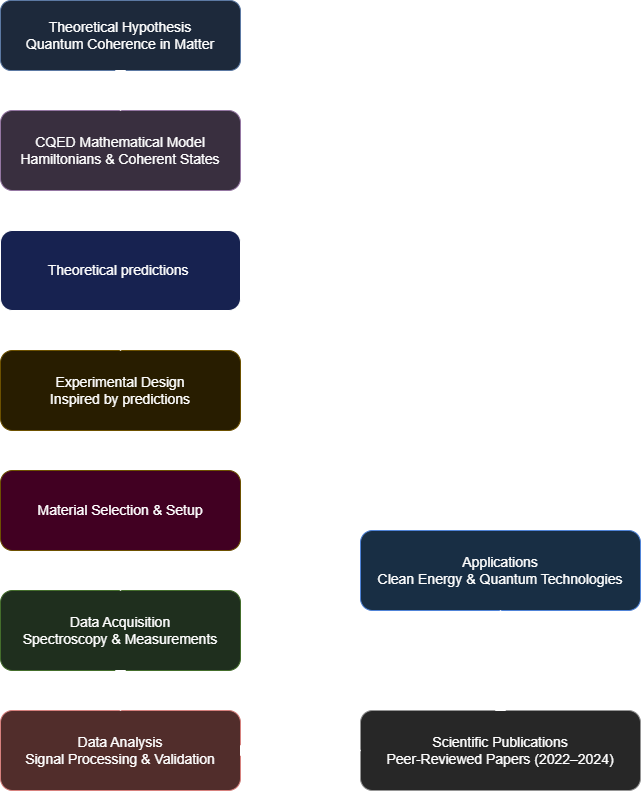
Our systematic approach from theoretical predictions through experimental validation to practical applications
Peer-Reviewed Publications (2022-2024)
Experimental Study on Deuterium Production from Titanium Hydride Powders
Gamberale, L. & Modanese, G. • Symmetry 16(11):1542 (2024)
Mass spectrometry analysis revealed anomalous deuterium-to-hydrogen ratios during thermal cycling of titanium hydride powders. The deuterium concentration increased by approximately 280 times compared to natural abundance, confirmed through three independent measurement methods. Flow calorimetry showed no measurable excess heat in the tested configuration. These findings align with theoretical predictions of ultra-low momentum neutron generation through coherent electron capture mechanisms.
Commercial Relevance:
First experimental demonstration of deuterium production via coherent neutron generation in metal hydrides, providing direct validation of CQED predictions for low-energy nuclear reactions.
Spectral Analysis of Proton Eigenfunctions in Crystalline Environments
Gamberale, L. & Modanese, G. • Quantum Reports 6(2):14 (2024)
We compute the maximum amplitude of coherent oscillation of protons in a metal hydride, constrained by the periodic electrostatic potential generated by electrons in the metallic crystal. This calculation determines the energy gap of the coherent state and demonstrates that bound states display a harmonic oscillator-like structure. The calculated energy gap (0.37 eV) significantly exceeds thermal energies at operational temperatures, ensuring coherent state stability against thermal decoherence.
Commercial Relevance:
Establishes theoretical foundations for coherent proton oscillations in metal lattices and quantifies the conditions necessary for stable quantum coherence in condensed matter systems.
Numerical Simulations Unveil Superradiant Coherence in a Lattice of Charged Quantum Oscillators
Gamberale, L. & Modanese, G. • Physica B: Condensed Matter 671:415381 (2023)
Numerical simulations demonstrate superradiant phase transitions in a lattice of charged quantum oscillators coupled to electromagnetic fields. The system exhibits collective coherent behavior above critical density thresholds, with enhanced light-matter coupling mediated by bulk plasmons. Results show emergence of energy gaps and coherent electromagnetic modes confined within the material.
Commercial Relevance:
Computational validation of theoretical predictions for superradiant transitions in charged oscillator lattices, providing numerical evidence for enhanced coupling mechanisms in dense quantum systems.
We present fully second-quantized calculations showing spontaneous emergence of coherent electromagnetic field configurations interacting with charged bosons in regular lattices. Under specific frequency relationships between plasma oscillations and electrostatic confinement, coherent states exhibit negative energy gaps relative to perturbative ground states. The calculation includes diamagnetic terms and considers three-dimensional wavefunctions with momentum quantized in all directions.
Commercial Relevance:
Rigorous quantum field theory demonstration of coherent state formation in charged boson lattices, establishing conditions for ground state instability and spontaneous coherence emergence.
This work examines coherent vibrational states of quantum plasmas formed by conduction electrons and protons in metal hydrides. When coherently excited, these configurations can transfer energy through weak interactions to produce ultra-low energy neutrons via electron capture. The coherent states are characterized by energy gaps of approximately 1 eV per particle and remain dynamically stable. The theory enables theoretical calculation of neutron production rates.
Commercial Relevance:
Theoretical framework predicting neutron generation through coherent weak interactions in metal hydrides, providing the conceptual foundation for subsequent experimental validations.
Key Milestones
Proof of Concept
Successfully demonstrated 280x increase in deuterium concentration—experimental confirmation of theoretical predictions and key validation milestone.
IP Foundation
Developed proprietary theoretical framework published in peer-reviewed journals, establishing foundational IP for future commercial applications.
International Recognition
Presented at ICCF-26 (2025), gaining peer recognition and visibility among international research groups and potential partners.
Reproducible Methods
Established multi-method validation protocols ensuring results are robust, reproducible, and suitable for scaling to commercial applications.
Market Applications
Multiple pathways to commercialization across high-value sectors
Industrial Heat
Process heat for manufacturing, chemical production, and heavy industry—replacing fossil fuels in hard-to-decarbonize sectors worth $500B annually
Distributed Power
Compact generators for data centers, remote facilities, and backup power—a $200B market growing at 8% annually
Medical Isotopes
On-demand production of diagnostic and therapeutic isotopes—addressing critical shortages in a $10B market
Energy Storage Alternative
High-density energy systems that could complement or replace battery storage in grid applications
Note: Applications represent target markets based on technology development milestones. Current focus is on validating core technology for initial commercial deployment.
Aligned With Global Priorities
Our technology addresses critical challenges facing governments, industries, and investors worldwide.
ESG & Sustainability
Directly supports corporate and national net-zero commitments. Clean energy without the intermittency challenges of renewables or the waste issues of conventional nuclear.
Energy Security
Reduces dependence on fossil fuel imports and volatile commodity markets. Hydrogen fuel can be produced locally from water anywhere in the world.
Regulatory Tailwinds
EU Green Deal, US IRA, and Asian clean energy mandates are creating massive incentives for breakthrough energy technologies—over $500B in committed public funding.
About BitsBreeze
BitsBreeze is an Italian deep-tech company founded in 2025, developing next-generation clean energy technology based on quantum coherence phenomena in condensed matter. We combine world-class scientific expertise with a clear path to commercialization.
Our Mission
To bring breakthrough clean energy technology from laboratory validation to commercial deployment, creating transformative value for investors while addressing humanity's greatest challenge.
Our Approach
We follow a milestone-driven development model with clear technical and commercial gates. Each phase is designed to de-risk the technology while building toward scalable applications.
Strategic Network
Partnered with leading research institutions and international collaborators. Our network provides access to world-class facilities and expertise.
Research & Industry Partners
A strong ecosystem of academic and commercial partners accelerating our path to market.
LEDA Energy srl
Research Collaboration Partner
Research vehicle and sponsor providing PI salary support. Partnership renewal planned to continue collaborative experimental programs and knowledge sharing.
Vantasner AG
Validation Study Co-Partner
Swiss partner providing Co-PI allocation, AI/LLM methodology support, and laboratory expenses. Key partner in validation studies and experimental infrastructure.
Let's Talk
Interested in partnership, investment, or learning more about our technology?
Laboratory Address
Viale dell'Innovazione, 10
20126 Milano, Italia